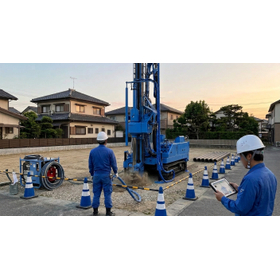
Ground reinforcement work Product List and Ranking from 5 Manufacturers, Suppliers and Companies | IPROS

Last Updated: Aggregation Period:Sep 30, 2026~Oct 27, 2026
This ranking is based on the number of page views on our site.

Ground reinforcement work Manufacturer, Suppliers and Company Rankings

Last Updated: Aggregation Period:Sep 30, 2026~Oct 27, 2026
This ranking is based on the number of page views on our site.

  1. ジオテック Tokyo//Other construction industries
  2. 基土木 Okinawa//Other construction industries
  3. 地研テクノ Kanagawa//Construction Consultant
  4. 4 東特 Saitama//Structural Design Office
  5. 5 アースリレーションズ Tokyo//others

Ground reinforcement work Product ranking

Last Updated: Aggregation Period:Sep 30, 2026~Oct 27, 2026
This ranking is based on the number of page views on our site.

  1. Ground reinforcement work "Daku Pile Method (Small Diameter Steel Pipe Piles)" 基土木
  2. Ground reinforcement work for commercial facilities | Reducing construction costs and duration with DM method ジオテック
  3. Ground reinforcement work | Reduce costs with the ETP method for shortened construction periods and easy removal! ジオテック
  4. Ground Investigation | A Smart Foundation Specification Explanation Method to Eliminate Excess Piles in Single-Story Logistics Warehouses ジオテック
  5. 4 Ground reinforcement work | Achieving reliable trust with public evaluation and performance certification through the RES-P method. ジオテック

Ground reinforcement work Product List

1~30 item / All 34 items

Displayed results

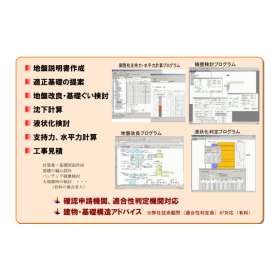
Foundation ground design support

A service where specialized foundation engineers assist with design.

This is a service where specialized engineers in foundation ground support the design. We comply with legal regulations, various standards, guidelines, and other specialized requirements.

  • Ground foundation construction method
  • Ground improvement
  • Consulting companies
  • Ground reinforcement work

Added to bookmarks

Bookmarks list

Bookmark has been removed

Bookmarks list

You can't add any more bookmarks

By registering as a member, you can increase the number of bookmarks you can save and organize them with labels.

Free membership registration

Ground reinforcement construction "Kushibe(R) method"

We achieve low-cost, high-strength, and high-quality ground reinforcement work!

The "Kushi Bie(R) Method" is a mechanical mixing deep mixing treatment method that constructs improved bodies by excavating and mixing slurry-type cement-based solidifying materials with the in-situ ground. It employs a uniquely developed excavation and mixing device that features vertical protrusions on the counter-rotation prevention wings and the mixing wings above and below them. This enables construction at low axial rotation speeds and high velocities. Additionally, it significantly contributes to the improvement of the quality of the improved bodies. 【Features】 ■ Low cost ■ Time reduction ■ High strength ■ High quality *For more details, please download the PDF or feel free to contact us.

  • Renovation and repair methods
  • Ground foundation construction method
  • Civil Engineering Method
  • Ground reinforcement work

Added to bookmarks

Bookmarks list

Bookmark has been removed

Bookmarks list

You can't add any more bookmarks

By registering as a member, you can increase the number of bookmarks you can save and organize them with labels.

Free membership registration

Ground reinforcement work "Cross Wing Column Method"

Excellent adaptability at a low cost! We provide high-quality and reliable construction.

The "Cross-Wing Column Method" is a slurry-based mechanical mixing deep mixing treatment method that achieves stable mixing performance with minimal variation, unaffected by soil conditions, through a jointly developed excavation mixer. With proven quality backed by numerous experimental results, it is adaptable for various applications such as buildings, retaining walls, and other structures. This method has a small quality control surcharge coefficient, which helps to reduce excessive material usage. Additionally, by adopting Inspection Method A, quality inspections can be conducted at minimal cost. Furthermore, appropriate selection of the improved diameter can lead to shortened construction periods and cost reductions. 【Features】 ■ High Quality ■ Adaptability ■ Low Cost *For more details, please refer to the PDF document or feel free to contact us.

  • Renovation and repair methods
  • Ground foundation construction method
  • Civil Engineering Method
  • Ground reinforcement work

Added to bookmarks

Bookmarks list

Bookmark has been removed

Bookmarks list

You can't add any more bookmarks

By registering as a member, you can increase the number of bookmarks you can save and organize them with labels.

Free membership registration

Ground reinforcement construction "SMD Pile Method"

No soil disposal required! A steel pipe pile method suitable for the construction of low to mid-rise buildings in urban spaces.

The "SMD Pile Method" is a construction method that involves rotating a steel pipe pile with spiral wings (outer wings) attached to the outer circumference of the pile tip, approximately 2 to 3 times the diameter of the pile, in a right-hand rotation for penetration. The interior of the pile tip is open-ended, and a spiral wing (inner wing) is attached inside the steel pipe, creating a structure that achieves support capacity nearly equivalent to that of a completely closed system. Additionally, this method allows for construction with low noise and low vibration, making it an environmentally friendly technique that does not generate excavated soil or muddy water. 【Features】 ■ High Quality ■ Low Cost ■ Ecology *For more details, please refer to the PDF materials or feel free to contact us.

  • Renovation and repair methods
  • Ground foundation construction method
  • Civil Engineering Method
  • Ground reinforcement work

Added to bookmarks

Bookmarks list

Bookmark has been removed

Bookmarks list

You can't add any more bookmarks

By registering as a member, you can increase the number of bookmarks you can save and organize them with labels.

Free membership registration

Ground reinforcement construction "Shinbee Method"

Expanding the scope and lineup! Ground reinforcement work using soil-cement columns.

The "Shinbi Method" is a ground reinforcement technique that constructs soil cement columns by excavating and mixing the ground while discharging a slurry of cement-based solidifying material, and utilizes a thin-walled steel pipe with joints embedded at the center as a ground reinforcement body. The excavation and mixing device of this method is equipped with multiple vertical protrusions on the anti-rotation wings and the upper and lower mixing wings to enhance the mixing performance of the cement-based solidifying material slurry and the ground. By using this excavation and mixing device, it enables construction at low axial rotation speeds and high velocities, while significantly improving the quality of the modified body. 【Features】 ■ Low cost ■ Reduced residual soil ■ High strength ■ High bearing capacity *For more details, please refer to the PDF document or feel free to contact us.

  • Renovation and repair methods
  • Ground foundation construction method
  • Civil Engineering Method
  • Ground reinforcement work

Added to bookmarks

Bookmarks list

Bookmark has been removed

Bookmarks list

You can't add any more bookmarks

By registering as a member, you can increase the number of bookmarks you can save and organize them with labels.

Free membership registration

Ground reinforcement construction "Kanbei Raft Method"

Introduction to a composite ground reinforcement method using straight steel pipes with a tip fitting that has a hole.

The "Kanbee Raft Method" is a technique that involves the rotational insertion and burial of a pile-like ground reinforcement material (hereinafter referred to as "reinforcement material") which has excavation claws and a tip fitting welded to the end of a steel pipe. This method utilizes the combined support capacity of the reinforcement material and the underlying foundation soil. By making the tip fitting the same outer diameter as the steel pipe, it is possible to effectively obtain the support capacity of the underlying foundation soil and the lateral resistance of the reinforcement material without disturbing the surrounding soil. 【Features】 ■ Considers the support capacity of both the underlying foundation soil and the ground reinforcement material ■ Economical ■ Short construction period ■ High quality ■ High support capacity *For more details, please refer to the PDF document or feel free to contact us.

  • Ground foundation construction method
  • Ground reinforcement work

Added to bookmarks

Bookmarks list

Bookmark has been removed

Bookmarks list

You can't add any more bookmarks

By registering as a member, you can increase the number of bookmarks you can save and organize them with labels.

Free membership registration

[Knowledge of Ground] Characteristics and Challenges of Ground Guarantee

The purpose of the NPO Housing Ground Quality Association is to improve the quality of residential ground and eliminate ground-related accidents!

This column explains the establishment, characteristics, issues, and challenges of ground guarantees. It introduces topics such as "The History of Ground Surveys for Detached Houses," "Ground Guarantees and Damage Insurance," "Types of Ground Guarantees," and "The Decrease in Differential Settlement Accidents." For more details, please refer to the related links. We encourage you to read it. 【Contents (Partial)】 ■1. Introduction ■2. The History of Ground Surveys for Detached Houses ■3. The History of Ground Guarantees ■4. Ground Guarantees and Damage Insurance ■5. Types of Ground Guarantees *For detailed content of the column, please refer to the related links. If you have any questions, feel free to contact us.

  • Ground foundation construction method
  • Site and ground investigation
  • Ground reinforcement work

Added to bookmarks

Bookmarks list

Bookmark has been removed

Bookmarks list

You can't add any more bookmarks

By registering as a member, you can increase the number of bookmarks you can save and organize them with labels.

Free membership registration

Ground reinforcement construction "RES-P method"

Strengthening weak ground to protect the safety of homes! A method for reinforcing the foundation ground of small buildings.

The "RES-P Method" is a type of piled raft foundation method that strengthens weak ground by driving pipes (thin steel tubes) into the ground, utilizing the combined effect of the ground and the pipes to prevent settlement, serving as a foundation reinforcement method for residential buildings. To support the load of the building, the number, position, and penetration depth of the pipes driven into the ground are determined and designed according to the condition of the ground. As of August 2011, the maximum length of the pipes has been extended from 7m to 14m, allowing for application in deeper soft ground. This method is applicable to buildings with up to three stories, a total floor area of 1,500m2 or less, and a long-term ground pressure of 50kN/m2 or less. 【Features】 ■ Strengthens weak ground ■ Can be constructed to a depth of 14m ■ Planar ground reinforcement method ■ Low vibration and low noise during construction *For more details, please refer to the PDF materials or feel free to contact us.

  • Renovation and repair methods
  • Ground foundation construction method
  • Civil Engineering Method
  • Ground reinforcement work

Added to bookmarks

Bookmarks list

Bookmark has been removed

Bookmarks list

You can't add any more bookmarks

By registering as a member, you can increase the number of bookmarks you can save and organize them with labels.

Free membership registration

Ground reinforcement work "Kanbei Method"

A pile-type ground reinforcement method that can effectively obtain circumferential resistance without disturbing the surrounding ground.

The "Kanbee Method" is a technique that utilizes a steel pipe with a welded tip that has excavation claws and holes, which is rotated and driven into the ground for use as a pile-like ground reinforcement material. The characteristics of the tip used in this method include having the same outer diameter as the steel pipe, possessing a tip cone and excavation claws, and having two holes. Additionally, a feature of the construction management is the confirmation of bearing capacity through impact loading tests after the driving is completed. 【Features】 ■ Uses a straight steel pipe with a tip that has holes ■ Economical ■ Short construction period ■ High quality ■ High bearing capacity *For more details, please refer to the PDF document or feel free to contact us.

  • Ground foundation construction method
  • Ground reinforcement work

Added to bookmarks

Bookmarks list

Bookmark has been removed

Bookmarks list

You can't add any more bookmarks

By registering as a member, you can increase the number of bookmarks you can save and organize them with labels.

Free membership registration

Ground reinforcement work "Daku Pile Method (Small Diameter Steel Pipe Piles)"

Developing weak ground! A ground reinforcement construction method with high performance evaluation, featuring low vibration and low noise.

The "Dacpile Method (Small Diameter Foundation Steel Pipe Piles)" utilizes high-strength, corrosion-resistant Dacpile pipes and incorporates the miniaturization of heavy machinery, enabling construction in difficult-to-access locations and narrow sites for ground reinforcement work. Dacpile features an integrally formed tip blade and pile body, possessing robust and uniform material strength throughout all parts. Additionally, the enlarged base effect of the tip blade allows for significant vertical load-bearing capacity due to the increased blade area. 【Features】 ■ Adoption of high-strength, corrosion-resistant Dacpile pipes ■ Realization of no-welding on-site ■ 10-year construction warranty *For more details, please download the PDF or feel free to contact us.

  • Renovation and repair methods
  • Special Construction Method
  • Ground reinforcement work

Added to bookmarks

Bookmarks list

Bookmark has been removed

Bookmarks list

You can't add any more bookmarks

By registering as a member, you can increase the number of bookmarks you can save and organize them with labels.

Free membership registration

Ground reinforcement work "Columnar Improvement Method"

The improved ground can maintain the strength to support the building for a long time!

The "Columnar Improvement Method" involves injecting cement milk into stable ground, compacting the soil into columnar shapes using machinery, and then constructing a foundation on top of it. Columns made of a cement-based solidifying agent (soil improvement cement) mixed with soil, referred to as columns, are created within the ground. By selecting the appropriate soil hardening agent, this method can accommodate improvement work for various soil types, including clay and sand. 【Process】 ■ Using specialized construction machinery, excavate to the planned depth while injecting the cement-based solidifying agent. ■ Reverse the construction machinery to mix the soil and cement-based solidifying agent. ■ Raise and lower the pit of the construction machinery to mix the entire area. ■ Completion is achieved once the material is fully solidified. *For more details, please download the PDF or feel free to contact us.

  • Ground foundation construction method
  • Ground improvement
  • Site and ground investigation
  • Ground reinforcement work

Added to bookmarks

Bookmarks list

Bookmark has been removed

Bookmarks list

You can't add any more bookmarks

By registering as a member, you can increase the number of bookmarks you can save and organize them with labels.

Free membership registration

Settlement correction work | Identifying buried debris causing settlement in investigation gaps! Pressure plate renovation approach

Identify the subsidence of buried waste lurking in the gaps of the survey points! Revitalize the substructure before renovation with pinpoint underground exploration and pressure plate jacking.

When planning large-scale renovations or seismic reinforcement work, debris and buried waste hidden in the gaps of ground survey data can pose a hidden risk of uneven settlement, leading to floor re-tilting or fixture malfunctions after the completion of the construction. No matter how much the upper structure is renewed, if the foundation and the underlying ground's softening are left unaddressed, the building's inherent longevity cannot be achieved. At Geotech, we conduct hand auger drilling and pinpoint underground exploration as part of the ground and foundation diagnosis before starting renovations, visualizing the extent of buried waste and settlement factors as objective numerical data. In the leveling process, we apply a pressure plate jack-up method that does not require extensive demolition work, using small hydraulic jacks to achieve precise horizontal restoration in millimeter increments, leveraging the building's own weight as a reaction force. After lifting, we pressure-inject high-flow air bubble mortar (air milk) into the voids under the floor to equalize the ground pressure, and we encapsulate the damaged cloth foundation structure with high-adhesion epoxy resin to restore structural strength beyond that of new construction. Geotech's settlement correction work menu enhances the overall quality and durability of the renovation.

  • Renovation and repair methods
  • Residential foundations
  • Consulting companies
  • Ground reinforcement work

Added to bookmarks

Bookmarks list

Bookmark has been removed

Bookmarks list

You can't add any more bookmarks

By registering as a member, you can increase the number of bookmarks you can save and organize them with labels.

Free membership registration

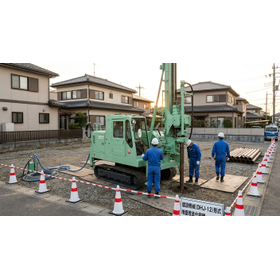
Ground reinforcement work | Reduce costs with the ETP method for shortened construction periods and easy removal!

A next-generation ground reinforcement ETP method that achieves both shortened construction periods and cost reduction. It builds a solid foundation quickly with no soil disposal and no curing.

This document explains the importance of "ground reinforcement work" in achieving total cost reduction and shortening construction periods in construction projects, as well as the features of the "ETP method" that make this possible. In addressing soft ground, traditional methods faced challenges such as costs for disposing of excess soil and time losses due to curing periods. The ETP method is a soil displacement method that involves rotating and pressing a steel pipe equipped with a disc-shaped expansion wing and a drilling auxiliary bit into the ground. Since it does not use cement, there is no need for a curing period, allowing for immediate transition to the next process after pouring, and there are no costs for soil disposal. Additionally, during reconstruction, the piles can be easily removed and recovered by reversing the rotation, making it an economical and sustainable choice for future land use. With a combination of 16 sizes of pile diameters ranging from φ89.1mm to φ609.6mm and high-strength steel pipes, optimal designs without waste are possible. GeoTech Co., Ltd. significantly contributes to streamlining construction periods and costs while maintaining quality by managing construction data in real-time and ensuring prompt and accurate construction arrangements.

  • Ground improvement
  • Ground foundation construction method
  • Pile and foundation work
  • Ground reinforcement work

Added to bookmarks

Bookmarks list

Bookmark has been removed

Bookmarks list

You can't add any more bookmarks

By registering as a member, you can increase the number of bookmarks you can save and organize them with labels.

Free membership registration

Ground reinforcement work | Strengthening structural seismic resistance with the ETP method, which is strong in both pushing and pulling!

Strongly responds to pushing and pulling! ETP method enhances seismic resistance. The disc-shaped tip wings counteract loads from multiple directions, ensuring the safety of structures.

This document provides a detailed explanation of advanced technologies for "ground reinforcement work" and the "ETP method," which dramatically enhance the seismic resistance and safety of structures against multi-directional loads caused by earthquakes and strong winds. To prevent differential settlement and tipping accidents on soft ground, a reliable foundation structure that can withstand not only compressive loads but also tensile forces is essential. The ETP method is a rotary driven steel pipe pile method equipped with a disc-shaped enlarged wing and excavation auxiliary bit at its tip, which has received certification from the Minister of Land, Infrastructure, Transport and Tourism and has been publicly proven to have support performance in both compression and tension directions. The construction method, which does not use cement and generates no soil displacement, prevents soil contamination while achieving high penetration and strong resistance by compacting the surrounding ground. With a total of 16 sizes of pile diameter variations and the selection of high-strength 590N grade steel pipes, optimal designs without waste can be achieved even under complex stress conditions. GeoTech Co., Ltd. uses construction management equipment that automatically records rotational torque and penetration depth to accurately determine the reach of the support layer, providing reliable foundation work that is strong against earthquakes nationwide.

  • Residential foundations
  • Renovation and repair methods
  • Other civil engineering works
  • Ground reinforcement work

Added to bookmarks

Bookmarks list

Bookmark has been removed

Bookmarks list

You can't add any more bookmarks

By registering as a member, you can increase the number of bookmarks you can save and organize them with labels.

Free membership registration

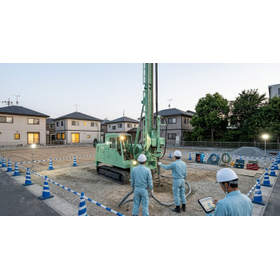
SMD method for visualizing construction data and ensuring quality for apartment building construction.

Visualizing reliable construction quality through real-time data tracking with construction management devices and ISO quality management.

In the condominium construction industry, the stability of the ground is extremely important for the long-term safety of buildings and the maintenance of asset value. Ground subsidence can affect the structure of buildings, potentially leading to increased repair costs and decreased asset value. Therefore, a quantitative ground assessment and advanced site management to reduce subsidence risk are required. The SMD pile method by Geotech Co., Ltd. is a Minister of Land, Infrastructure, Transport and Tourism certified rotary-driven steel pipe pile method that leverages construction visualization and a strict quality control system to address these challenges. 【Usage Scenarios】 - Ground reinforcement in new condominium construction - Objective stopping judgment through comparison with ground survey data - Achieving uniform construction quality independent of operator experience 【Benefits of Implementation】 - Assurance of structural safety of buildings - Maintenance of asset value through reduced subsidence risk - Response to various ground guarantees backed by reliable data

  • Residential foundations
  • Renovation and repair methods
  • Other civil engineering works
  • Ground reinforcement work

Added to bookmarks

Bookmarks list

Bookmark has been removed

Bookmarks list

You can't add any more bookmarks

By registering as a member, you can increase the number of bookmarks you can save and organize them with labels.

Free membership registration

Ground reinforcement work | Providing objective assurance with the CWC method of GBRC performance certification.

The Cross-Wing Column Method enhances the reliability of ground reinforcement work. It objectively demonstrates structural safety with a reliable technology that has obtained GBRC performance certification.

To ensure the safety and durability of architectural structures, ground reinforcement work based on objective technical evidence is essential. The Cross Wing Column Method (CWC Method) developed by Geotech Co., Ltd. is a highly reliable deep mixing treatment method that has obtained the GBRC performance certification (No. 12-17 Rev. 1) from the Japan Building Disaster Prevention Association. The patented intersecting six-blade mixing wings efficiently and forcibly mix the local soil with cement slurry, forming high-quality columns that are not affected by soil quality. It can accommodate sandy soils, clayey soils, and loam layers, adapting to a wide range of design conditions with public evidence, including design strength standards of 400 to 1500 kN/m² and a maximum improvement length of 22 m (12 m for small-scale projects). Additionally, for small-scale buildings, the omission of mixing tests and inspection method A using mold cores are permitted, ensuring quality at a third-party certification level while keeping costs and construction periods down. Geotech provides reliable ground reinforcement under strict QMS management, facilitating smooth building confirmation applications. Please feel free to contact us.

  • Ground improvement
  • Ground foundation construction method
  • Pile and foundation work
  • Ground reinforcement work

Added to bookmarks

Bookmarks list

Bookmark has been removed

Bookmarks list

You can't add any more bookmarks

By registering as a member, you can increase the number of bookmarks you can save and organize them with labels.

Free membership registration

Ground reinforcement work | Constructing high-strength piles with the Pure Pile method that are unaffected by soil conditions.

We propose the Pure Pile method, which forms pile-like reinforcement using high-strength cement milk without mixing with local soil, preventing any influence from soil conditions and avoiding differential settlement.

To ensure the structural safety of buildings over a long period, it is essential to accurately analyze the characteristics of the local ground and to carry out appropriate ground reinforcement work to prevent uneven settlement. The Pure Pile method proposed by Geotech Co., Ltd. is an innovative ground reinforcement technology that constructs pile-like reinforcement bodies by directly replacing the ground with high-strength cement milk while expanding the ground laterally using a conical excavation head. Because it uses a 100% cement milk structure without mixing with local soil, it is unaffected by soil quality in diverse ground conditions, including humus layers, and can consistently demonstrate the planned high strength and quality. By evenly distributing a large number of reinforcement bodies with a design pile diameter of 20 cm, it supports the building load in a balanced manner across the surface, achieving high vertical bearing capacity and effectively eliminating the risk of settlement accidents in structures. Additionally, due to the construction structure that generates almost no residual soil, it reduces the costs of transporting and disposing of leftover soil from the site. At Geotech, under an ISO-certified quality management system, specialized construction technicians thoroughly manage real-time data to provide reliable and trustworthy foundation reinforcement.

  • Residential foundations
  • Renovation and repair methods
  • Other civil engineering works
  • Ground reinforcement work

Added to bookmarks

Bookmarks list

Bookmark has been removed

Bookmarks list

You can't add any more bookmarks

By registering as a member, you can increase the number of bookmarks you can save and organize them with labels.

Free membership registration

Ground improvement work | Achieving reduction of leftover soil and total cost reduction with the Pure Pile method.

Significantly reduce disposal costs with a no-excavation structure that minimizes the generation of excess soil. Geotech proposes the Pure Pile method, which balances high load-bearing capacity and excellent economic efficiency.

To prevent building differential settlement accidents and ensure long-term structural stability, prior ground analysis and appropriate ground reinforcement work are essential. The Pure Pile Method proposed by Geotech Co., Ltd. is an environmentally friendly foundation reinforcement technology that directly constructs pure pile bodies underground using high-strength cement milk. This method employs a construction principle that expands the ground laterally while penetrating, and the use of straight rods that do not produce excavated soil dramatically reduces the amount of residual soil generated on-site. By minimizing the occurrence of residual soil removal work and disposal costs, significant total cost reductions are achieved. Additionally, since it does not mix with locally generated soil, it is unaffected by soil quality, ensuring high support performance even in humus-rich ground. By designing a balanced arrangement of numerous small-diameter reinforcement bodies with a design pile diameter of 20 cm, it disperses the building load and eliminates the risk of differential settlement in advance. Geotech provides safe and high-quality construction under a strict construction management system certified by ISO, recording on-site data in real time.

  • Residential foundations
  • Renovation and repair methods
  • Other civil engineering works
  • Ground reinforcement work

Added to bookmarks

Bookmarks list

Bookmark has been removed

Bookmarks list

You can't add any more bookmarks

By registering as a member, you can increase the number of bookmarks you can save and organize them with labels.

Free membership registration

Ground reinforcement using CWC method for residential buildings | Geotech

Visualizing construction data and ground reinforcement work that supports the long-term asset value of apartment buildings.

In the operation of residential complexes, ensuring the safety of buildings and maintaining asset value are extremely important. To reduce the risk of uneven ground subsidence and ensure the long-term stability of buildings, a management system that can objectively demonstrate construction quality is essential. If construction records are unclear, it may affect future repair plans and asset value assessments. GeoTech Co., Ltd.'s CWC method provides accurate data that supports the acquisition of bearing capacity as designed through digital visualization of construction management, offering reliable ground guarantees. 【Usage Scenarios】 - Foundation ground reinforcement for newly constructed residential complexes - Ensuring ground safety aimed at maintaining long-term asset value - Large-scale construction projects requiring traceability 【Benefits of Implementation】 - Objective quality assurance through automatic measurement and storage of all construction data - Reliable ground reinforcement using methods that obtain GBRC performance certification - Smooth application of ground guarantee insurance for risk management

  • Residential foundations
  • Renovation and repair methods
  • Other civil engineering works
  • Ground reinforcement work

Added to bookmarks

Bookmarks list

Bookmark has been removed

Bookmarks list

You can't add any more bookmarks

By registering as a member, you can increase the number of bookmarks you can save and organize them with labels.

Free membership registration

Foundation reinforcement using the Geo Column method for commercial facilities | Geotech

Ensure reliable quality control for large-scale foundations of commercial facilities through the visualization of construction data.

In large-scale buildings such as commercial facilities, it is essential to objectively and rigorously manage the quality of the ground improvement body to ensure long-term safety. Proving the construction quality underground, which is not visible, directly relates to maintaining the reliability of the facility. The Geo-Column method supports the construction of a reliable foundation by demonstrating the establishment of the support layer and the formation of a homogeneous improvement body according to design through real-time data collection using automated management measurement devices. 【Usage Scenarios】 - Ground reinforcement during the construction of large commercial facilities - Construction of foundation slabs requiring high bearing capacity - Projects that require objective proof of construction quality 【Benefits of Implementation】 - Ensured transparency of quality through real-time visualization of construction data - Reliable establishment of support layers based on numerical data - Long-term traceability maintained through electronic storage

  • Residential foundations
  • Renovation and repair methods
  • Other civil engineering works
  • Ground reinforcement work

Added to bookmarks

Bookmarks list

Bookmark has been removed

Bookmarks list

You can't add any more bookmarks

By registering as a member, you can increase the number of bookmarks you can save and organize them with labels.

Free membership registration

Ground reinforcement using the Pure Pile method for residential construction | Geotech

We prevent uneven settlement of houses with high-strength cement milk replacement piles that are not affected by soil conditions.

In residential construction sites, it is essential to accurately assess the ground bearing capacity and implement appropriate reinforcement work to prevent differential settlement, in order to maintain the safety of the building over the long term. Depending on the nature of the ground, traditional mixing methods may pose a risk of quality variation, making it challenging to ensure stable support strength. The Pure Pile method is chosen as a solution to reduce the risk of settlement in homes, as it does not mix site-generated soil with cement, allowing for the formation of high-strength pile-like reinforcements as planned, unaffected by soil quality. 【Usage Scenarios】 - Ground reinforcement during the construction of single-family homes - Measures against differential settlement in diverse ground conditions such as humus layers - Construction sites looking to reduce soil disposal costs - Small-scale buildings with three stories or fewer and a total floor area of less than 1,500 square meters 【Benefits of Implementation】 - High quality stability with 100% cement milk replacement piles - Reduction of site burden and costs by minimizing generated soil - Distributed support of building loads through evenly spaced piles with a design diameter of 20 cm - Assurance provided by technology that has obtained GBRC performance certification

  • Ground improvement
  • Ground foundation construction method
  • Pile and foundation work
  • Ground reinforcement work

Added to bookmarks

Bookmarks list

Bookmark has been removed

Bookmarks list

You can't add any more bookmarks

By registering as a member, you can increase the number of bookmarks you can save and organize them with labels.

Free membership registration

【ER Ground School】Session 5: Things to Be Careful About When Choosing Land Freely (1)

How to investigate land disaster risks and natural disaster risks! How to utilize the researched disaster risks?

The ER Ground School is a ground course for small-scale buildings, delivered in collaboration between ground consultants (represented by Blue Sage Co., Ltd.) and Earth Relations. In the fifth session, we will clearly explain "Things to be careful about when choosing land freely (1)" through a PowerPoint video. We will introduce how to investigate land disaster risks and natural disaster risks. For more details, please refer to the related link. [Key Points] 1. Types of land disaster risks 2. How to investigate natural disaster risks 3. Liquefaction countermeasures *For more information, please check the related link page or feel free to contact us.

  • Ground foundation construction method
  • Site and ground investigation
  • Ground reinforcement work

Added to bookmarks

Bookmarks list

Bookmark has been removed

Bookmarks list

You can't add any more bookmarks

By registering as a member, you can increase the number of bookmarks you can save and organize them with labels.

Free membership registration

[ER Ground Improvement Seminar] Session 7: What is Ground Reinforcement Anyway?

Deepening understanding of ground reinforcement work! Tips for selecting construction methods (comparison estimates) will also be introduced!

The ER Ground Seminar is a ground course aimed at small-scale buildings, delivered in collaboration with a ground consultant (representative of Blue Sage) and Earth Relations. In the 7th session, we will clearly explain "What is ground reinforcement?" through a PowerPoint video. We will discuss "There are terrains and soils that are unsuitable for ground reinforcement methods" and "The unsuitable terrains and soils differ by method." [Key Points of the Discussion] 1. Ground reinforcement is not piling. 2. Types of methods. 3. Method selection based on terrain and soil (visualization). *For more details, please refer to the related link page or feel free to contact us.

  • Ground foundation construction method
  • Site and ground investigation
  • Ground reinforcement work

Added to bookmarks

Bookmarks list

Bookmark has been removed

Bookmarks list

You can't add any more bookmarks

By registering as a member, you can increase the number of bookmarks you can save and organize them with labels.

Free membership registration

【ER Foundation Seminar】Session 9: Selecting Reinforcement Methods to Prevent House Tilting

Learn about ground reinforcement methods based on land conditions! An explanation of land conditions that are prone to differential settlement accidents!

The ER Ground School is a ground course for small-scale buildings, delivered in collaboration with a ground consultant (representative of Blue Sage Co., Ltd.) and Earth Relations. In the 9th session, we will clearly explain "Selecting Reinforcement Methods to Prevent House Tilting" through a PowerPoint video. We will discuss "Land Conditions Prone to Differential Settlement Accidents" and "Considerations for Selecting Methods Based on Each Land Condition." [Key Points of Discussion] 1. Land Conditions Prone to Differential Settlement Accidents - Confirming examples of causes of differential settlement 2. Considerations for Selecting Methods Based on Each Land Condition - Reasons why caution is needed for certain lands - Key points for method selection *For more details, please refer to the related link page or feel free to contact us.

  • Ground foundation construction method
  • Site and ground investigation
  • Ground reinforcement work

Added to bookmarks

Bookmarks list

Bookmark has been removed

Bookmarks list

You can't add any more bookmarks

By registering as a member, you can increase the number of bookmarks you can save and organize them with labels.

Free membership registration

【ER Ground School】 Session 12: Summary of Residential Ground

Simple checkpoints to prevent sinking accidents! The priority in ground examination is "consideration to avoid tilting the house"!

The ER Ground School is a ground course for small-scale buildings, delivered in collaboration with a ground consultant (represented by Blue Sage Co., Ltd.) and Earth Relations. In the 12th session, we provide a clear explanation of "Summary of Residential Ground" through a PowerPoint video. We summarize simple checkpoints to prevent differential settlement accidents. [Key Points] ■1. Topography ■2. Ground investigation data ■3. Ground reinforcement estimates (selection of reinforcement methods) ■4. Ground insurance and guarantees *For more details, please refer to the related link page or feel free to contact us.

  • Ground foundation construction method
  • Site and ground investigation
  • Ground reinforcement work

Added to bookmarks

Bookmarks list

Bookmark has been removed

Bookmarks list

You can't add any more bookmarks

By registering as a member, you can increase the number of bookmarks you can save and organize them with labels.

Free membership registration

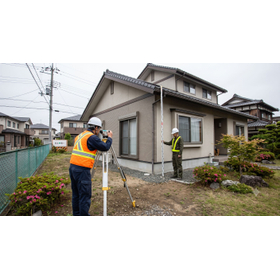
Ground Investigation | A Smart Foundation Specification Explanation Method to Eliminate Excess Piles in Single-Story Logistics Warehouses

Elimination of excessive piles in single-story logistics warehouses! By changing to direct foundations using shallow soil bearing capacity data from plate load tests, we smartly achieve cost reduction and the client's satisfaction.

In the construction plan for single-story logistics warehouses, the designation of expensive deep pile foundations or columnar improvements due to the underestimation of safety factors is a significant issue that severely pressures construction costs. This document explains a smart foundation explanation technique using "plate load tests" to measure the true bearing capacity of the shallow ground directly beneath the foundation and eliminate excessive ground reinforcement work. Geotech's plate load tests directly measure the ultimate bearing capacity and deformation coefficients at the actual pressure surface level, scientifically supporting design changes to direct foundations such as slab foundations. High-precision settlement simulations based on staged loading data prevent the risk of unevenness and settlement of the floor slab associated with forklift operations and the installation of high-rise racks. Furthermore, the eco-foundation proposal, which minimizes the generation of excavation spoil, also contributes to CO2 emission reduction. By presenting clear technical evidence, we fulfill the requirements for structural compatibility assessment and accountability to clients, strongly supporting significant cost reductions and shortened construction periods. We encourage you to utilize this document to achieve a highly satisfactory optimal foundation design.

  • ボーリング.jpg
  • Site and ground investigation
  • Geological Survey Company
  • Geological Survey
  • Ground reinforcement work

Added to bookmarks

Bookmarks list

Bookmark has been removed

Bookmarks list

You can't add any more bookmarks

By registering as a member, you can increase the number of bookmarks you can save and organize them with labels.

Free membership registration

Ground reinforcement work | Achieving reliable trust with public evaluation and performance certification through the RES-P method.

Obtain public evaluation and performance certification! Ground reinforcement RES-P method that supports buildings for a long time based on clear design standards such as evaluations from the Japan Building Center.

To ensure the structural safety of newly constructed buildings over the long term, reliable ground reinforcement work is essential. Uneven settlement due to insufficient ground bearing capacity can cause cracks in exterior walls and tilting of the building, significantly reducing asset value. The RES-P method, a piled raft foundation construction method, provides extremely high structural reliability to address these issues. This method has obtained architectural technical performance certification from the General Incorporated Foundation Japan Building Disaster Prevention Association (GBRC Performance Certification No. 04-02) and evaluation from the Japan Building Center (BCJ-F872), allowing for reinforcement design based on clear calculation standards recognized by public institutions. By improving the bearing capacity beneath the foundation through the combined effects of slender steel pipes and the ground, it can be adapted to strip foundations and mat foundations without special foundation structural reinforcement. As it employs a non-dredging penetration method that does not use cement-based solidifying agents, it reduces the cost of disposing of excess soil while keeping the site environment clean. GeoTech Co., Ltd. offers absolute peace of mind to clients through thorough quality control and data assurance systems using construction management devices.

  • Residential foundations
  • Renovation and repair methods
  • Other civil engineering works
  • Ground reinforcement work

Added to bookmarks

Bookmarks list

Bookmark has been removed

Bookmarks list

You can't add any more bookmarks

By registering as a member, you can increase the number of bookmarks you can save and organize them with labels.

Free membership registration

Ground reinforcement work for commercial facilities | Reducing construction costs and duration with DM method

No welding required, reducing costs and construction time without soil displacement. Achieving reliable ground reinforcement.

In commercial facilities, a strong foundation is required to ensure the long-term safety of the building and the peace of mind of its users. Particularly in facilities that are used by many people, ensuring earthquake resistance against disasters such as earthquakes is crucial. Ground subsidence and differential settlement can affect the structure of the building and potentially compromise safety. Therefore, reliable ground reinforcement work is essential. Our DM method achieves economical and reliable ground reinforcement, supporting the safe operation of commercial facilities. 【Usage Scenarios】 - Ground improvement for new commercial facilities - Enhancing earthquake resistance of existing commercial facilities - Ground reinforcement in narrow sites or urban areas 【Benefits of Implementation】 - Ensured safety through improved earthquake resistance of the building - Reduced risk of ground subsidence - Cost reduction for construction - Shortened construction period

  • Residential foundations
  • Renovation and repair methods
  • Other civil engineering works
  • Ground reinforcement work

Added to bookmarks

Bookmarks list

Bookmark has been removed

Bookmarks list

You can't add any more bookmarks

By registering as a member, you can increase the number of bookmarks you can save and organize them with labels.

Free membership registration

Ground reinforcement using cost-reduction DM methods for factories and warehouses.

No welding required, contributes to stable equipment in factories and warehouses without soil displacement.

In the construction and operation of factories and warehouses, a solid foundation that supports the stable operation of large equipment and precision machinery is essential. Ground subsidence and fluctuations increase the risk of equipment failure, production line stoppages, and even serious accidents. Therefore, reliable ground reinforcement work is required. GeoTech Co., Ltd.'s DM method (Double Metal Method) provides an economical and reliable solution to these challenges. 【Application Scenarios】 - Ground reinforcement during the construction or expansion of factories and warehouses - Ground improvement in areas for large machinery installation - Subsidence countermeasures for existing facilities - Construction in narrow sites or areas with limited road width 【Benefits of Implementation】 - Increased productivity due to stable operation of equipment - Reduced risk of ground subsidence - Cost savings through reduced construction costs and shortened construction periods - Decreased disposal costs for excess soil

  • Residential foundations
  • Renovation and repair methods
  • Other civil engineering works
  • Ground reinforcement work

Added to bookmarks

Bookmarks list

Bookmark has been removed

Bookmarks list

You can't add any more bookmarks

By registering as a member, you can increase the number of bookmarks you can save and organize them with labels.

Free membership registration

SMD method for visualizing construction data and ensuring reliable quality for residential construction.

Visualizing reliable construction quality through real-time data tracking and ISO quality management.

In the residential construction industry, the stability of the ground is extremely important to ensure the long-term safety and durability of buildings. In particular, improving earthquake resistance against natural disasters such as earthquakes is an essential factor in protecting the safety of residents. To prevent the risk of ground subsidence in advance and guarantee the structural safety of buildings, quantitative ground evaluation and advanced site management are required. The SMD pile method provided by Geotech Co., Ltd. is a Minister of Land, Infrastructure, Transport and Tourism certified rotary-driven steel pipe pile method that leverages visualization of construction and a strict quality control system to address these challenges. 【Usage Scenarios】 - Ground reinforcement for new residential buildings - Improvement of earthquake resistance for existing homes - Reduction of differential settlement risks 【Benefits of Implementation】 - Uniform and high construction quality that does not depend on the operator's experience - Increased reliability through scientific and objective stopping criteria - Response to various ground guarantees backed by reliable data

  • Residential foundations
  • Renovation and repair methods
  • Other civil engineering works
  • Ground reinforcement work

Added to bookmarks

Bookmarks list

Bookmark has been removed

Bookmarks list

You can't add any more bookmarks

By registering as a member, you can increase the number of bookmarks you can save and organize them with labels.

Free membership registration